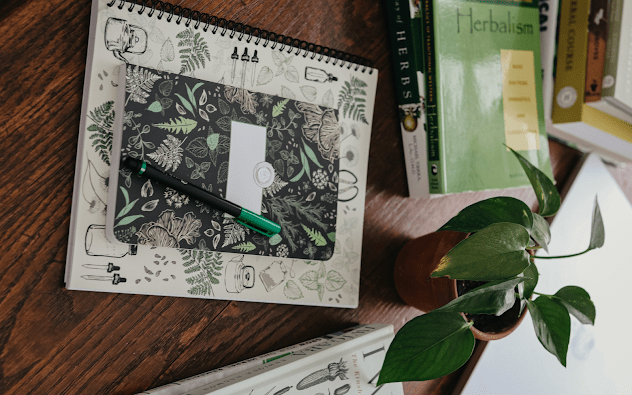
Over the last few years, I’ve enrolled in three different holistic education programs, clinical herbalism, Ayurveda, and wellness coaching.
People ask me all the time which school they should go to to become a holistic practitioner. I always wish I had an easy answer, but the truth is, holistic education doesn’t work like regular schooling.
There isn’t one place that teaches everything. It’s spread out across different systems, traditions, and philosophies.
At first, that really confused me.
I couldn’t understand why learning about the body meant jumping from one school to another, from one framework to the next. It felt like trying to put together a puzzle without ever seeing the full picture.
Over time, I realized there’s a reason for it. These healing systems developed in different cultures, in different parts of the world, long before modern education existed.
Ayurveda, western herbalism, coaching, and functional medicine all grew on their own paths. There isn’t one perfect school, just the next piece of the journey.
That being said, not all holistic schools are created equal.
Before choosing any program, I spent a lot of time researching so I wouldn’t waste money on surface-level or overly simplified education.
The schools I’ve attended are solid, well-structured, and genuinely teach depth. The red flags I’m about to mention are things I’ve noticed in other programs out there, not the ones I chose.
One big red flag for me is when schools jump straight into remedies without explaining how the body actually works.
When students are taught what to take without understanding what’s happening inside the body, healing turns into guesswork.
Real holistic care isn’t about memorizing protocols. It’s about understanding patterns, systems, and why something that helps one person might make another feel worse.
Another red flag is when intuition is pushed as the main tool without being backed by anatomy, physiology, and real understanding.
Intuition can be helpful, but without knowledge to support it, it can also lead people in the wrong direction.
Some of the programs I’ve taken have been incredibly deep and changed how I think about the body. Others were more focused on communication and working with people.
Each one added something different, and together they helped me see health in a much bigger, more connected way.
The biggest lesson for me wasn’t about which school was “the best.”
It was realizing that becoming a practitioner isn’t about collecting certifications. It’s about learning how the body works as a whole, how systems affect each other, and how to think instead of chasing quick fixes.
I also learned how important discernment is.
Not every philosophy within holistic education lined up with my personal beliefs, and that’s okay. Learning to take what aligns and leave what doesn’t actually made my education stronger, not weaker. It taught me that you can grow without compromising your values.
More than anything, this journey showed me how overwhelming the wellness world can feel when you’re truly trying to learn and not just follow trends.
That’s why I’m now creating my own educational space, one that brings everything together in a clearer, more grounded way, so others don’t have to feel as lost as I once did.
Credentials matter, but understanding matters more.
Choose your education based on how you think, how you learn, and the kind of healer you want to become, not what looks impressive online.
If you’re curious about the specific schools I attended and my honest breakdown of each one, I shared the full review over on The Passionate Herbalist, My holistic wellness website. I shared the link here: https://www.thepassionateherbalist.com/blogj/my-honest-experience-of-wellness-and-holistic-medicine-schools
 Honestly, Vanessa