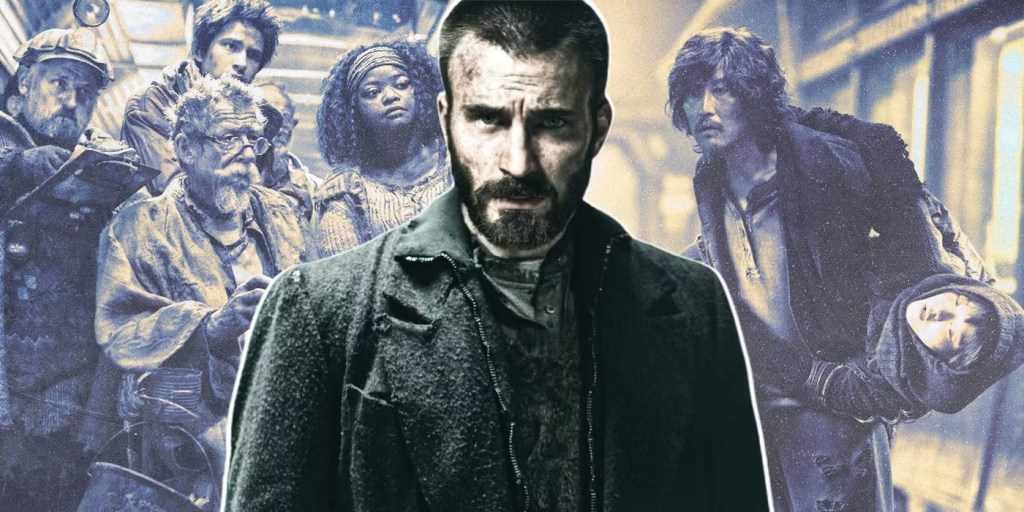
Directed by Bong Joon-ho, Snowpiercer is one of those sci-fi films that I always recommend to people to watch. It’s provocative, strange, and sometimes darkly funny while exploring themes of class struggle, social inequality, and moral corruption.
The world has frozen over after a failed climate experiment. The last of humanity lives on a train that circles the globe nonstop. But this train isn’t just transportation. It’s a moving social ladder.
The poor are stuck in the back.
The rich live in luxury at the front.
And the engine keeps everything alive.
That simple setup becomes the backbone of the entire film.
The story follows Curtis, a quiet but intense leader from the tail section. The people in the back live in cramped, dark, almost prison like conditions. They eat these disgusting protein bars and get punished if they ever step out of line.
Eventually, they revolt and fight their way to the front!
What makes the story so powerful is how physical it is. To move up in the world, they literally have to move forward through each of the train cars.
Every new section reveals a different world: a classroom, a nightclub, a sushi bar, a greenhouse, etc. Each one feels like a different world almost.
It’s not just a rebellion. It’s a journey through layers and layers of society.
And by the time Curtis reaches the front, the movie shifts from action to something more philosophical. The final conversation changes everything you thought the revolt meant.
So the cinematography feels tight and claustrophobic because most of the movie takes place in narrow train cars, and you can just feel that.
The camera often moves forward with the characters. The framing is tight. You rarely feel open space. Even fight scenes feel compressed, like there’s nowhere to run.
The tail section is filmed in dark blues and grays. It feels cold and hopeless.
As the resistance group move forward, the lighting changes. Colors get brighter. Spaces get wider. The world literally opens up.
The classroom scene is a perfect example. It’s bright, colorful, almost cheerful, but it’s deeply disturbing. The contrast between innocence and propaganda is chilling.
The cinematography doesn’t just show the world. It explains it visually.
The editing mirrors the train itself.
In the beginning, everything feels slow and heavy. The pacing reflects oppression. Life in the tail is repetitive and exhausting.
When the revolt begins, the editing becomes sharper and more aggressive. Cuts are quicker. Fight scenes feel chaotic but controlled, like the train never fully loses balance.
There’s a brutal fight sequence in near darkness that uses minimal light and long takes. It’s disorienting on purpose. You feel what the characters feel.
The film knows when to speed up and when to pause. The final act slows down again, forcing you to sit with uncomfortable truths.
Curtis could have been a simple action hero, but he isn’t. He carries guilt. He’s tired. He’s not sure if he even deserves to lead. This is very human.
Minister Mason is a completely unhinged woman in a very theatrical way. She’s cartoonish but terrifying. Her exaggerated mannerisms feel ridiculous at first, but that’s the point. Power often hides behind absurdity.
Kang-ho Song brings a different energy. He’s not interested in the political revolution the way Curtis is. He has his own goal. His presence reminds us that survival isn’t one-size-fits-all.
Even Wilford (the unseen engine master for most of the film) becomes more complex when we finally meet him. He’s calm. Rational. Almost gentle. And that makes him even more disturbing.
Nobody feels purely good or purely evil. Everyone is part of the system in some way.
Wilford claims the system must stay in place for survival. The poor must remain poor. The rich must remain comfortable. The engine must be protected at all costs.
It’s about how systems convince people that inequality is necessary.
The protein bars are a symbol too. Processed survival. People in the back are literally fed the lowest form of life to keep the system running.
The children taken from the tail section? That’s the future being absorbed into the machine.
And the snow outside? It represents both death and possibility. The system says the outside world is unlivable. But is it?
The final image suggests that maybe survival doesn’t come from maintaining the system. Maybe it comes from destroying it.
What I love about Snowpiercer is that it forces you to question whether “balance” is sometimes just controlled cruelty.
It’s gritty but imaginative, violent but thoughtful, and simple in structure, but layered in meaning.
It’s a sci-fi movie that feels very real.
 Honestly, Vanessa
Leave a comment