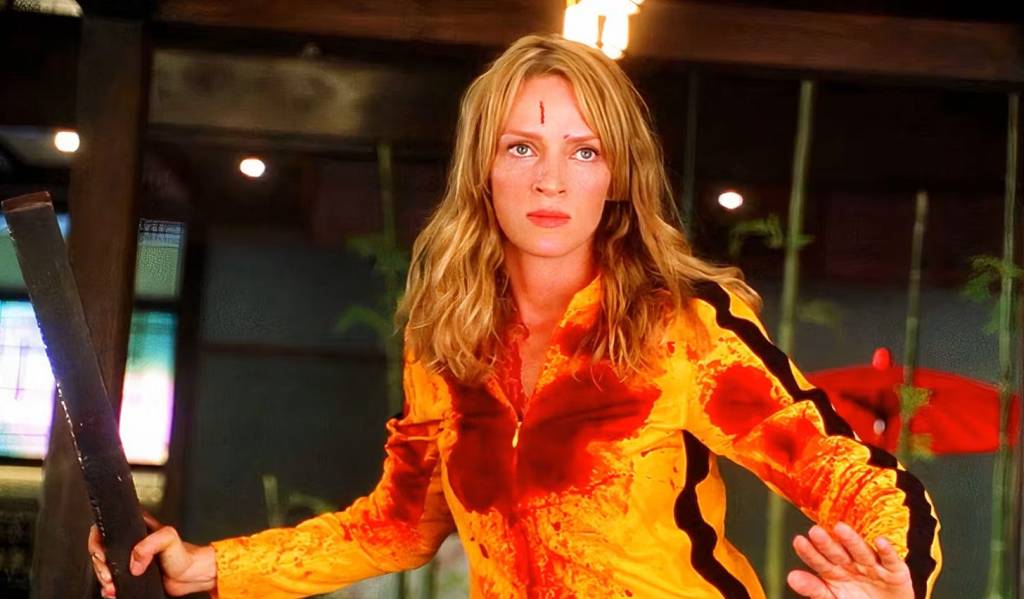
Kill Bill was one of those movies I never expected to love as much as I did. As a kid, I didn’t fully understand all the symbolism, the genre-blending, or the emotional weight behind The Bride’s story but it was really cool for it’s time and there was definitely something about it that grabbed me immediately.
I’m not really into action films that much, but it was the aesthetic, the attitude, the emotion underneath the violence, and the iconic female lead who felt larger than life. The film had this bold, stylized world that felt almost mythological, and I didn’t realize then how much it would shape my taste in cinema.
Let’s begin with the Aesthetic. From the yellow jumpsuit, soundtracks, anime cuts, samurai silence, I strongly believe that they are the key reasons why Kill Bill stays burned into our memories. Every frame is intentional, I mean Tarantino spent almost a decade planning, writing and shooting this film and you can tell.
Every color has meaning, every sound cue is emotional punctuation. Tarantino didn’t just make a revenge film. He made a visually stylized masterpiece whoo and once you’ve witnessed it, you will never forget it.
The Bride’s yellow jumpsuit does more than reference Martial Arts and Bruce Lee, it also sets the tone for her entire identity. It’s bright, impossible to ignore, almost glowing against the darker scenes. Yellow is also the color of caution tape. When she walks into a room wearing that suit, she’s not hiding. She’s announcing herself. It’s highly memorable, vulnerable and aggressive.
The soundtrack in Kill Bill is one of the greatest ever created, not because it matches the scenes, but because it creates them. Songs like “Don’t Let Me Be Misunderstood,” “Bang Bang (My Baby Shot Me Down),” and the eerie whistles of “Twisted Nerve” give every moment emotional texture. The music shifts between melancholic lullabies, razor-sharp tension, spaghetti-western grit, and jaw-dropping hype. It’s a playlist of her psyche.
I could write at least 20 pages on my favorite scenes so I’ll just keep it sweet and short for the sake of not overwhelming you guys.
The Hospital Revenge Scene. This scene is insane in the best way, discovering that men were being brought in to sleep with her while she was in a coma is one of the most disturbing twists in the film, and her revenge is brutally satisfying. It’s the moment The Bride wakes up not just physically, but as a force of justice, reclaiming her power in the most unapologetic way possible.
O-Ren Ishii’s Anime Backstory. The anime sequence is one of the most brilliant artistic decisions in the entire film. Tarantino using anime to tell O-Ren’s trauma is sort of genius because it makes her pain operatic, stylized, and emotionally larger than life. Animation lets trauma be illustrated in ways live-action cannot capture which is so smart: the blood flows like ink, the grief is theatrical. I always cry at this part even though it’s not a live action scene.
The House of Blue Leaves scene is pure aesthetic violence. I don’t typically enjoy films with a lot of violence, but this film is obviously an exception mostly due to the aesthetic. The neon lights, silhouettes, and choreography makes it feel like a graphic novel is coming to life. When O-Ren Ishii walks with her entourage to the House of Blue Leaves and “Battle Without Honor or Humanity” hits? Instant chills. Instant dopeness. Today it may be a little cringey, but it was iconic for its time. This scene is where The Bride transforms from a vengeful woman into a mythic force, and it is visually unforgettable.
Some of the most powerful moments in Kill Bill aren’t loud, they’re silent. The snowy courtyard fight between The Bride and O-Ren is quiet in a way that feels spiritual. The crunch of snow under their feet, the soft wind, and that delicate shakuhachi flute paired with the steady rhythm of the bamboo water fountain you hear tipping and resetting all throughout, creating a scene that feels meditative in the middle of chaos. Tarantino understood something most directors don’t and that’s silence can be an aesthetic too. It heightened the tension. I never knew that could be achieved without any sort of loud music. So genius.
Every piece of Kill Bill’s aesthetic comes from somewhere, Tarantino took inspiration from kung fu films, Japanese cinema, anime, grindhouse, samurai epics, westerns and yet none of it feels borrowed. It feels like an innovation. The film’s world is loud, soft, beautiful, grotesque, serious, playful, feminine, and deadly, all at the same time. No wonder why it stayed with me since childhood. It’s the kind of aesthetic that imprints on your imagination.
Rewatching it as an adult, the film hits completely differently. The Bride isn’t just cool or powerful, she’s truly symbolic. She represents survival, rebirth, trauma, female rage, maternal devotion, discipline, and a form of feminine strength that isn’t softened for anyone’s comfort.
Tarantino mixed anime, kung fu classics, westerns, and 70s grindhouse aesthetics into one cinematic universe, and somehow it works perfectly. I’ve always been a big fan of his innovative, genre-blending style. And for me, Kill Bill became the kind of movie that lives in your mind forever, not just because of the action sequences, but because of how emotionally iconic it is.
 Honestly, Vanessa